


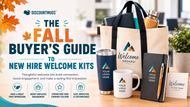
The Fall Buyer's Guide to New Hire Welcome Kits
Aug 20th 2026

Every September, the same thing happens. Offices refill, calendars fill up, and a stack of requisitions that sat quietly through August suddenly has names attached to them. Recruiters call it the September Surge — a reliable jump in both job postings and candidate activity that runs from Labor Day through late October.
Which means that if you're an HR manager, an office manager, or a marketing lead who owns employee experience, you're about to onboard more people in a shorter window than you did all summer. And the branded merchandise side of that — the welcome kit, the first-day mug, the tote that shows up before the laptop does — is usually the thing that gets remembered last and ordered in a panic.
This guide covers what actually goes in a good kit, what the research says about why kits are worth the line item, how to budget for one, and how to time an order so it lands before your start dates do.
Why Fall Is the Right Time to Buy
Three things stack up in September, and they all point the same direction.
Hiring volume climbs. The post-Labor-Day recruiting window is well documented across the HR industry. Teams come back from summer, roles that were parked get reopened, and companies push to fill seats before the December slowdown. If your organization has a calendar fiscal year, September also kicks off the final quarter — its own urgency around getting people hired and productive before year-end.
Budgets have a deadline. Q4 is when unspent departmental budget either gets used or gets absorbed. Employee experience, onboarding, and internal marketing line items are frequently in that category. Ordering merchandise in September against a budget that expires in December is a much easier internal conversation than asking for money in January.
Order volume compounds in your favor. If you know you're onboarding people in September, October, and November, ordering for all three months at once puts you in a higher volume tier than three separate small orders would. Same total spend, better per-unit pricing, one artwork review instead of three. That last point is the single biggest lever most teams leave unpulled. Onboarding merch tends to get bought reactively, one start date at a time, at the worst possible price break.
The Business Case, in Numbers
Onboarding Is a Retention Problem — and Retention Is Expensive
The research on early-tenure turnover is consistent and unflattering. Roughly a third of employees who leave an organization leave within their first year, and a majority of those departures happen in the first six months. Around one in five exits occur inside the first 45 days.
The counterweight is that structured onboarding measurably changes those outcomes. Research from Brandon Hall Group puts the retention improvement from a strong onboarding process at around 82%. SHRM's work has found employees who report a good onboarding experience are substantially more likely to still be there at the three-year mark. Gallup's data has repeatedly shown that employees who experience excellent onboarding are far more likely to be engaged in their first year — and only about 12% of employees say their employer does onboarding well. That's a low bar to clear.
SHRM estimates replacing an employee runs between 50% and 200% of that person's annual salary depending on role and seniority. For a mid-level role at $70,000, a single avoided departure covers a great many welcome kits.
To be clear about what merchandise does and doesn't do: a branded tumbler doesn't retain anyone on its own. A kit is one visible signal inside a larger onboarding program. But it's the signal that arrives first, and it's the one a new hire can physically hold before they've met most of their team.
The Merchandise Keeps Working After Day One
The 2026 ASI Global Ad Impressions Study found that a typical promotional product generates around 3,300 brand impressions across its usable life, at an average cost-per-impression of about six-tenths of a cent. A $6 tote bag generates close to 5,000 lifetime impressions at roughly a tenth of a cent per impression.
A few other findings from the same study relevant to kit building:
- 85% of consumers can name the advertiser on a promotional item they own
- 78% keep promotional products because they find them useful
- 76% say they're more likely to do business with a brand that gave them branded merchandise
- 75% of U.S. consumers hold a positive view of branded merchandise — higher than television or digital advertising
ASI's category-level data on drinkware is especially useful for onboarding buyers: 87% of end users said they would keep a branded drinkware item because it's useful, more than three-quarters said they would use it at least weekly, and the category averages roughly 1,300 lifetime impressions — among the highest of any non-wearable product.
Read those two arguments together and the framing changes. A welcome kit is not a soft-cost perk. It's a retention touchpoint that doubles as one of the lowest-cost-per-impression advertising channels available to you, worn and carried by someone who has a genuine reason to like your brand.
What Actually Goes in a Kit
The strongest kits follow one rule: fewer, better items that a person will use in their normal week. A kit with fifteen things reads as a warehouse clearing. A kit with four things that are all good reads as intentional.
The Anchor Item
Every kit needs one piece that earns permanent desk or bag space. This is where the majority of your per-person budget should go, and where the impression math pays off most.
- Drinkware — a stainless tumbler, insulated travel mug, or ceramic mug. The most reliable anchor there is, because it enters someone's daily routine immediately and stays there. Fall timing helps — cooler weather brings hot-beverage drinkware back into rotation.
- Bags — a canvas tote, laptop bag, or backpack. One of the highest impression-generating categories in the ASI data, because they travel into public spaces. Also the most practical for a first day — the new hire needs somewhere to put things.
The Everyday Item
Something used constantly but not thought about much. Notebooks and portfolios, quality pens, and desk accessories all fit. The quality threshold matters more than the item — a pen that skips does more damage to the impression than no pen at all.
The Wearable
Apparel is one of the highest-recall categories in the ASI research. A tee, quarter-zip, or cap gives new hires something to wear to a team event without feeling like a walking billboard on day one. For fall specifically, sweatshirts and hoodies and beanies land better than short sleeves.
Two notes: sizing is the perennial headache — collect sizes during pre-boarding paperwork rather than guessing. And if apparel is going to blow the budget, defer it to a 90-day milestone gift rather than the day-one kit.
The Personal Touch
This costs almost nothing and consistently outperforms everything else in the box: a short, signed note from the hiring manager that mentions something specific about why the person was hired. Merchandise makes a kit feel prepared. The note makes it feel personal. You want both.
Optional, Budget Permitting
Tech accessories (chargers, laptop sleeves, phone stands), wellness items, and a small food or beverage item. These are additive, not foundational — reach for them once the anchor item is good, not instead of making the anchor item good.
Kit Tiers and Budget Math
Treat this as a planning frame rather than a quote — actual costs vary by product, decoration method, and quantity.
- Essentials tier — roughly $15–25 per person. Ceramic mug or basic tumbler, spiral notebook, quality pen, welcome note. Works well for high-volume hiring and hourly or seasonal roles.
- Standard tier — roughly $30–50 per person. Insulated stainless tumbler, canvas tote, notebook and pen set, tee or cap, welcome note. The most common configuration for salaried corporate roles.
- Premium tier — roughly $60–100+ per person. Premium drinkware, backpack or laptop bag, portfolio, quarter-zip or hoodie, tech accessory, welcome note in branded packaging. Suited to executive hires, specialized roles, or organizations where the hire represents a significant recruiting investment.
A worked example: 40 people onboarded between September and December at the standard tier, averaging $40 per kit, is a $1,600 order. Ordering all 40 at once rather than in four batches of ten typically moves you into a better volume tier and consolidates your setup and artwork steps. If those 40 kits contribute to keeping even one $70,000 mid-level employee who would otherwise have left in month four, the conservative end of SHRM's replacement-cost range puts that avoided loss at $35,000. The kits are a rounding error against it.
Ordering for In-Office, Remote, and Hybrid Teams
In-office is the simple case. Ship to one address, assemble kits internally, have them waiting at the desk on morning one.
Remote and hybrid is where kits matter most and logistics get harder. For a distributed hire, the kit is the only physical thing your company will ever hand them, and it arrives before they meet a single colleague on video. Two approaches work:
- Bulk-and-redistribute. Order everything to one location, assemble in-house, ship individually. More internal work, better per-unit pricing, full control over presentation.
- Split shipments. Have products sent to multiple addresses directly. DiscountMugs supports split shipments, which removes the internal assembly step for teams that don't have the bandwidth for it.
Whichever you pick, aim for the kit to arrive a few days before the start date — not on it. A box that shows up the Friday before someone starts does far more for first-day nerves than one waiting at a desk they haven't seen yet.
What to Skip
- Too many items. Volume doesn't read as generosity — it reads as inventory disposal. Four good items beat ten mediocre ones.
- Anything low-quality that gets used immediately. A pen that skips, a mug that chips, a tote with a strap that gives out. These get evaluated the moment they're used — a bad one becomes a small daily reminder that the company cuts corners.
- Novelty items with no daily use. Anything that has no place in someone's routine ends up in a drawer — zero impressions and zero goodwill.
- Over-branding. A logo on every surface makes items less likely to leave the house, which defeats the impression math entirely. One clean, well-placed mark travels much further than five.
- Guessed apparel sizes. A shirt that doesn't fit is a negative-value item. Ask first.
Timing Your Fall Order
Work backward from your earliest start date.
- Production: Standard production at DiscountMugs runs 6–10 business days, varying by product, order size, and decoration method. Rush options are available on select items at additional cost.
- Artwork review: Every order gets a free artwork review before anything goes to press — the step that catches a logo at the wrong resolution or an imprint color that won't reproduce cleanly. Production doesn't start until the proof is signed off.
- Assembly and shipping: If you're assembling kits internally or shipping to individual addresses, add that time on top.
A practical rule: place fall onboarding orders three to four weeks ahead of your earliest start date. For a wave of October and November hires, that means ordering in September — which also happens to be when the year's better volume pricing tends to be available.
One more thing worth doing now: order slightly more than your headcount forecast. Requisitions open unexpectedly, and having five spare kits on a shelf is far cheaper than placing a rush reorder for two.
Browse custom drinkware, tote bags and backpacks, branded apparel, and notebooks and portfolios to start building your fall kits — or head to corporate gifts for a curated view.
Frequently Asked Questions
What should a new hire welcome kit include?
At minimum: one anchor item that gets daily use (drinkware or a bag), one everyday item (notebook and pen), and a personal welcome note. Apparel and tech accessories are strong additions when budget allows. Cohesion matters more than quantity.
How much should we budget per employee?
Most corporate teams land between $30 and $50 per kit. Essentials-tier kits run $15–25, premium kits $60–100 or more. Volume-based discounts apply, so consolidating your fall hiring into one order improves per-unit cost.
What is the minimum order quantity?
Most items at DiscountMugs have a minimum order of 12, though this varies by product. For small teams, that usually means ordering a modest surplus — useful anyway for unexpected hires.
When should we place a fall order?
Three to four weeks before your earliest start date. Standard production runs 6–10 business days, plus artwork review, proof approval if required, and shipping.
Do welcome kits work for remote employees?
They're arguably more important for remote hires — the kit is the only tangible company experience a distributed employee gets. Split shipments make it manageable at scale.
Is a welcome kit actually worth the money?
The 2026 ASI research puts average cost-per-impression for promotional products at a fraction of a cent, with items generating thousands of brand views over their lifetime. Combined with SHRM's estimate that replacing an employee costs 50–200% of their salary, a kit program is one of the lower-risk line items in an employee experience budget.